
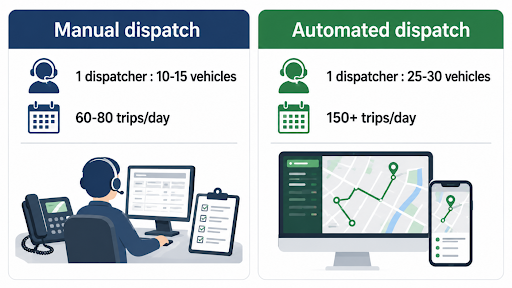
Most NEMT operators need one dispatcher for every 10 to 15 vehicles when trips are scheduled and monitored manually, and one dispatcher for every 25 to 30 vehicles once dispatching is automated. The ratio is set by daily trip volume and interruptions, not by how many vans sit in your lot.
That distinction matters, because two fleets of the same size can carry completely different dispatch loads.
Count Trips, Not Vehicles
A dispatcher’s workload is measured in trips touched per day, not vehicles assigned. Someone building routes in a spreadsheet, confirming pickups by phone and chasing will-call returns can handle roughly 60 to 80 trips a day before service quality slips. With automated assignment, live vehicle status and a driver app reporting arrivals, the same person can comfortably oversee 150 or more.
Use one calculation:
Daily trips ÷ trips per dispatcher = dispatchers needed at peak
A 20-vehicle fleet averaging 8 trips per vehicle per day produces 160 daily trips. Run manually, that is two dispatchers. Run on an automated platform, it is one dispatcher plus planned backup coverage.
Three Factors That Move the Ratio
These three factors directly affect how much work each dispatcher can realistically handle. The more complex the trips, systems, or service area become, the more dispatch capacity the operation usually needs.
Trip Mix
Standing orders for dialysis and recurring therapy are predictable and cheap to manage. Will-call returns, wheelchair trips and same-day broker add are not. A fleet running 30 percent will-call volume needs noticeably more dispatch hours than one built on standing orders.
Broker and Call Volume
Every broker portal checked by hand adds minutes to the day. Fleets pulling trips from several brokers without integration lose a large share of dispatcher time to data entry and status updates rather than to managing the road.
Service Area
Dense urban routes create short trips and frequent handoffs. Rural routes create fewer trips per vehicle but longer exception windows. Both changes how often the dispatcher is interrupted, which is the real limit on capacity.
Coverage Is a Separate Question from Capacity
Capacity tells you how many dispatchers you need at peak hour. Coverage tells you how many you need on payroll.
Any operation running a 12-hour service day needs at least two trained dispatchers, even at 8 vehicles. One person cannot cover a 5 a.m. first pickup and a 7 p.m. return, and a single point of failure becomes a missed trip the first time someone calls in sick.
Signs Your Ratio Is Wrong
These signs often point to a mismatch between dispatch capacity and daily workload. When several appear at the same time, staffing or operational systems may need attention.
- Driver calls go unanswered for more than two minutes during peak hours
- Will-call pickups routinely run past 45 minutes
- Trip documentation gets completed after the shift instead of during it
- Dispatchers spend afternoons correcting claim data instead of managing the road
- Same-day broker offers get declined because nobody has capacity to place them
Any two of these together usually mean the operation is one dispatcher short, or one system upgrade behind.
The Cheaper Way to Improve the Ratio
Adding headcount is the expensive fix. Removing manual work is the cheaper one. Automated trip import, optimised route building and a driver app that confirms arrivals without a phone call all raise the vehicles per dispatcher figure without lowering service quality.
For most growing fleets, the ceiling is not the dispatch team. It is the software the dispatch team is working around.
Darter routes and dispatches trips automatically, so your dispatchers manage exceptions instead of spreadsheets.

Start a Free Trial.
- Get a custom demo. Discover the value of Darter for your enterprise & our custom plans and pricing.
- Set up your Enterprise trial. See for yourself how Darter speeds up your workflow & impact.