
Over the past several months, Medicaid transportation oversight has intensified nationwide, especially following CMS-led pressure around provider revalidation, fraud prevention, and program integrity enforcement.
For transportation providers, brokers, and NEMT operators, recent enforcement actions, provider revalidation pressure, and fraud investigations across multiple states have made one thing increasingly clear: audits are no longer focused only on whether a trip was billed correctly.
Auditors are now evaluating whether transportation providers can operationally prove that trips were dispatched, performed, monitored, documented, and completed exactly as reported. That means providers are increasingly assessed on the quality of their operational records, dispatch visibility, GPS verification, and documentation consistency across the entire trip lifecycle.
Here’s what auditors are increasingly expecting.
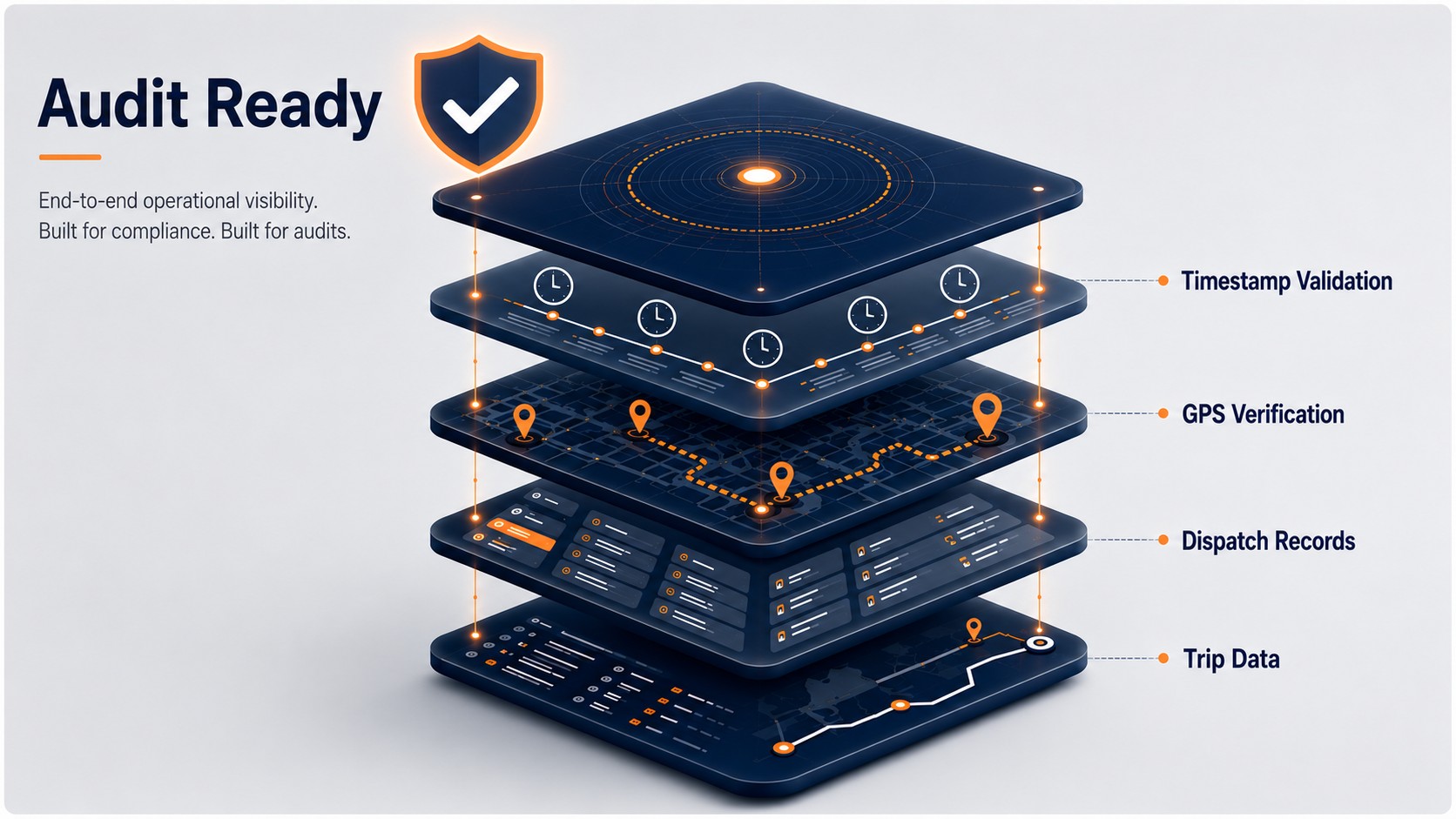
Stronger Digital Audit Trails
Auditors now expect transportation companies to maintain a complete digital record of each trip from assignment to completion. That includes:
- When the trip was scheduled and who assigned it
- When the driver accepted it
- GPS movement throughout the trip
- Pickup and dropoff timestamps
- Route deviations
- Communication logs
- Trip edits, adjustments, or cancellations
The goal is full operational traceability.
In several recent fraud investigations, regulators focused heavily on phantom billing, duplicate trips, and claims submitted without sufficient supporting operational evidence. As a result, providers are expected to maintain structured, timestamped records automatically rather than reconstructing them after the fact.
Retention requirements also matter. Medicaid programs and state agencies generally require multi-year retention of transportation and billing records, often ranging from 5 to 7 years, with some states requiring longer periods depending on provider type and program structure. Records must remain accessible and retrievable within audit timelines.
More Structured Dispatch Records
Dispatch is no longer just operational coordination. It is now audit evidence.
Auditors may evaluate:
- Trip assignment logic and dispatcher logs
- Whether dispatch activity matches billed trip records
- Driver schedule feasibility against trip volume
- Whether vehicles could realistically complete assigned routes
- Consistency between dispatch timelines and GPS data
In larger fleet environments, weak dispatch documentation is often a primary audit risk trigger. Mismatches between trip logs, timestamps, GPS data, and dispatch records can quickly escalate scrutiny.
This is driving a shift toward centralized dispatch platforms with structured, timestamped activity logs rather than relying on phone calls, spreadsheets, or fragmented communication tools.
Timestamp and Trip Verification
Timestamp integrity is now one of the most heavily reviewed audit components.
Auditors cross-check:
- Dispatch timestamps against driver app activity
- GPS movement against arrival and dropoff times
- Trip duration against billing submission timing
- Manifest records against all of the above
They look for inconsistencies such as:
- Unrealistically fast trip completion
- Overlapping transportation activity
- Missing GPS movement
- Manually altered timestamps
- Excessive idle gaps
Timestamp consistency is now directly tied to provider credibility during audits and investigations.
A growing part of this is Electronic Visit Verification (EVV). Originally introduced under the 21st Century Cures Act for personal care and home health services, EVV-style frameworks are increasingly influencing transportation-related Medicaid workflows in some states. While requirements vary, the direction is consistent: more GPS-based and timestamp-verified service validation. Missing or inconsistent verification data can result in claim denials or audit escalation in stricter jurisdictions.
Route Validation
Audits are increasingly reviewing actual route behavior, not just origin and destination.
This includes:
- GPS breadcrumbs and route history
- Mileage consistency against billed amounts
- Travel duration anomalies
- Unnecessary detours
- Vehicle movement patterns
This has become especially relevant in fraud investigations involving trips that could not realistically have occurred as billed or documented.
Providers are now expected to maintain continuous GPS visibility and verifiable route history across daily operations.
Cleaner Broker-Provider Data Flows
One of the most common audit failures comes from mismatched records across systems:
- Broker authorization data
- Provider dispatch logs
- Driver activity records
- Billing submissions
- GPS verification systems
Even small inconsistencies can trigger escalation if records do not align cleanly across platforms.
Increasingly, broker networks and state Medicaid programs maintain shared compliance histories and credentialing records, meaning provider performance issues in one network may influence scrutiny or eligibility in others. Both brokers and providers are being pushed toward better data synchronization, trip visibility, and centralized reporting.
Expanded Audit Scope Beyond Trip Data
CMS-style audits now extend beyond trip execution into broader provider operational legitimacy.
Auditors are reviewing not only whether a trip occurred, but whether the provider operating it is structurally compliant across personnel, vehicles, and data systems. This includes:
- Driver qualification files (licenses, background checks, certifications)
- Vehicle compliance records (registration, insurance, inspection, maintenance logs)
- HIPAA safeguards when dispatch systems handle patient-identifiable information
- System access controls and data protection practices
Audit scope is shifting from “did the trip happen” to “is the provider operationally compliant at every level.” Transportation providers are now being evaluated not just on service delivery, but on whether their entire operational environment can sustain consistent regulatory compliance under review.
What This Means for Transportation Providers
The broader shift happening across Medicaid transportation oversight is operational verification.
Transportation companies are increasingly expected to demonstrate not only that trips occurred, but that operational records consistently support how those trips were dispatched, routed, verified, and completed.
As CMS pressure, state oversight, and fraud enforcement continue expanding throughout 2026, this is creating major demand for:
- Routing software
- Compliance tooling
- Automated documentation systems
- Real-time tracking
- Centralized dispatch visibility
For many transportation providers and brokers, operational transparency is quickly becoming just as important as operational efficiency.
Whether it is a broker audit, a Medicaid integrity review, or a CMS or OIG-level investigation, the underlying expectation is the same: transportation providers must be able to produce consistent, end-to-end operational records across dispatch, routing, GPS activity, and billing.
Darter is built to meet them. Structured dispatch records, GPS-verified trips, timestamped audit trails, and centralized documentation, all in a single system.
Not sure where your gaps are? We’ll walk through it with you.