
Fleet software pricing comes in two shapes. You either pay for each van on the system, or you pay a base fee plus an amount for every trip you run. Neither one is cheaper on paper. The right answer depends on how busy your vans are, and it can flip as your fleet grows, which is worth settling before you compare dispatching platforms.
This guide runs both models through the three things that actually change your bill: a slow season, a growth spurt, and vans sitting idle. It is honest about where per-trip pricing ends up costing more.
The Two Shapes of Fleet Software Pricing
Almost every vendor prices one of three ways. Two are common, and the third is built around your fleet.
Per Vehicle
You pay a set amount for each van on the system, every month, whether that van runs 200 trips or 20.
NEMT Cloud Dispatch lists $49.99 a month for a single van, $149.99 flat for up to five, then $39.99 for each van after that. Bambi lists one flat rate of $69 per van per month with no tiers.
The appeal is that your bill is predictable. You know in January what December costs, and that alone makes per-van fleet software pricing easier to budget for.
Per Trip
You pay a base fee plus an amount for every trip the software handles. MediRoutes lists $150 a month plus $0.50 per managed trip with one broker connection, or $250 plus $0.50 with all of them.
The appeal is that a quiet month costs you less. Your bill moves with your work, which is the whole argument for per-trip fleet software pricing.
Custom Pricing
The vendor builds a plan around your fleet, your brokers and your volume. Darter works this way, with no setup fee, and gives you a rough figure through the fee calculator on its home page.
This suits fleets that do not fit neatly into either box, which is most fleets once they pass ten vans.
Run Both Models Against Your Own Numbers
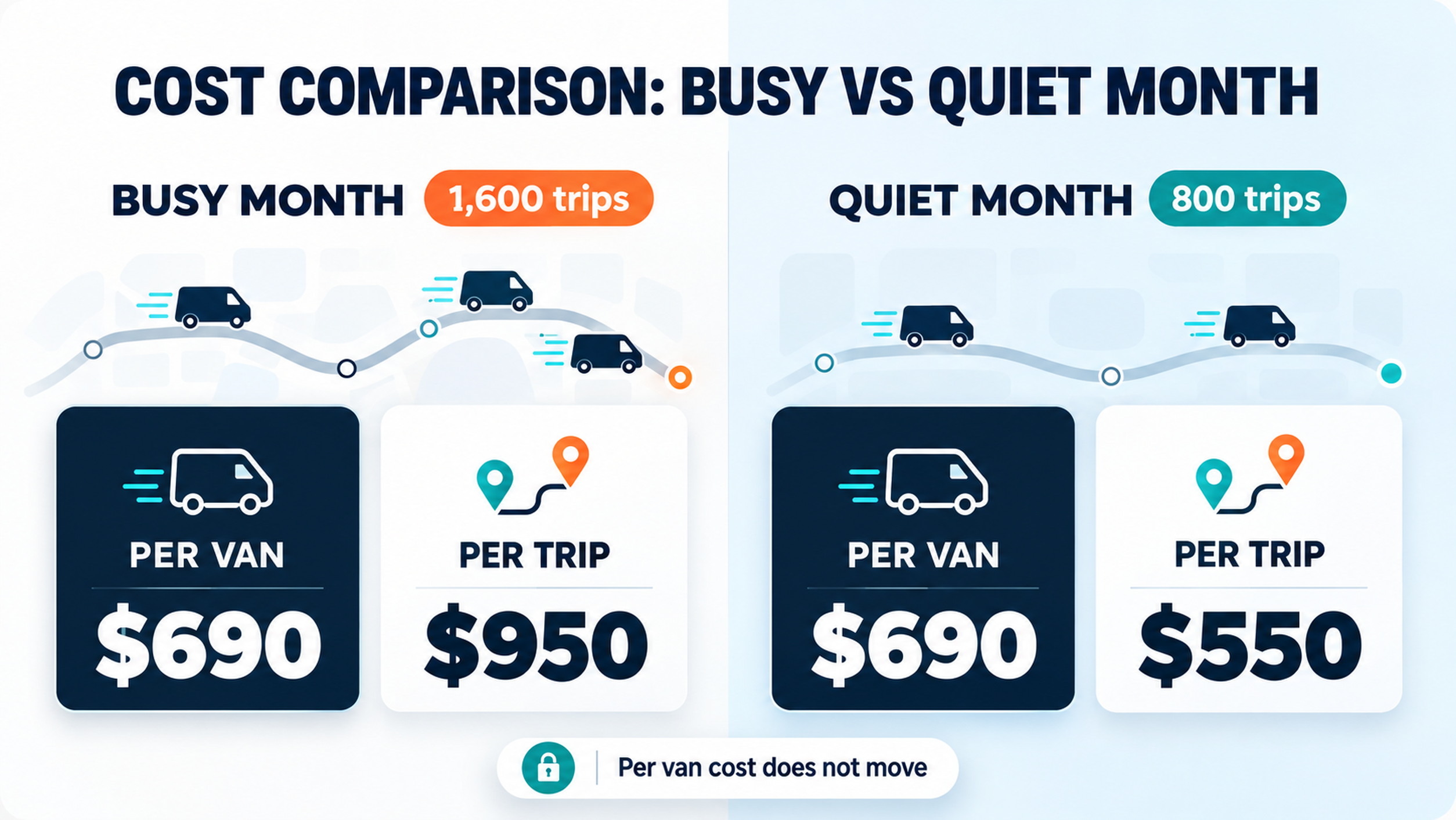
Take a real month and put it through both. Here is a 10-van fleet running 8 trips per van per day over 20 working days, which is 1,600 trips.
| How you pay | Published rate | Per month | Per trip |
|---|---|---|---|
| Per van, tiered | $149.99 plus $39.99 per van over 5 | $349.94 | $0.22 |
| Per van, flat | $69 per van | $690 | $0.43 |
| Per trip, one broker | $150 plus $0.50 per trip | $950 | $0.59 |
| Per trip, all brokers | $250 plus $0.50 per trip | $1,050 | $0.66 |
At this volume the per-van models win on fleet software pricing, and it is not close. The full breakdown sits in our guide to what NEMT software costs.
Now cut the trips in half and run it again. The per-van bills do not move at all. The per-trip bills drop to $550 and $650. That flip is the whole point of this comparison, and it is why fleet software pricing cannot be judged from a price page alone.
What Happens When Your Season Goes Quiet?
Most NEMT fleets have a slow stretch. Dialysis runs stay steady, but elective appointments thin out around holidays, bad weather cancels trips, and some markets drop off in summer.
In a quiet month, per-trip pricing protects you. If your volume falls 40%, your software bill falls with it. Per-van pricing does not care that your vans were parked. You pay the same either way.
So if your volume swings hard across the year, per-trip fleet software pricing is worth a serious look. If your volume is flat because standing orders carry the schedule, that protection is not worth paying for.
Be honest about how big the swing really is. A 10% dip does not justify a model that costs more for the other ten months of the year.
What Happens When You Grow?
Growth pushes fleet software pricing the other way, and it does it faster than most owners expect.
Adding vans raises a per-van bill in steps you can see coming. Adding trips raises a per-trip bill every single day. A fleet that wins a new broker contract can double its trips without adding a single van, and under per-trip pricing that is a doubled software bill on the same fleet.
There is also a quieter effect. Good routing lets you fit more trips into the same vans, which is exactly what you want. Under per-trip pricing, getting more efficient costs you more money. Under per-van pricing it costs you nothing.
That matters if you are actively working on your fleet utilization, because the software should not charge you a penalty for improving.
Idle Vans Are the Hidden Cost of Per-Van Pricing

Every fleet has a van that does not earn its keep. A spare that covers breakdowns. A wheelchair van that runs three days a week. A vehicle waiting on a driver you have not hired yet.
Under per-van pricing, each of those costs the same as your busiest vehicle. At $69 a van, a spare that runs occasionally costs $828 a year to keep on the system.
Two ways to handle it:
- Ask whether you can take a van off the system in months it is parked
- Ask whether the count is billed on active vans or every van in your account
Vendors answer this differently, and the answer rarely appears on the price page. Ask it directly before you sign.
The same goes for seasonal drivers. If you scale up for a busy quarter and back down after, find out whether fleet software pricing follows you down or only up.
Where Per-Trip Pricing Costs More Than You Expect?
This is the part most comparisons skip. Per-trip pricing looks cheap until you read how a trip is counted.
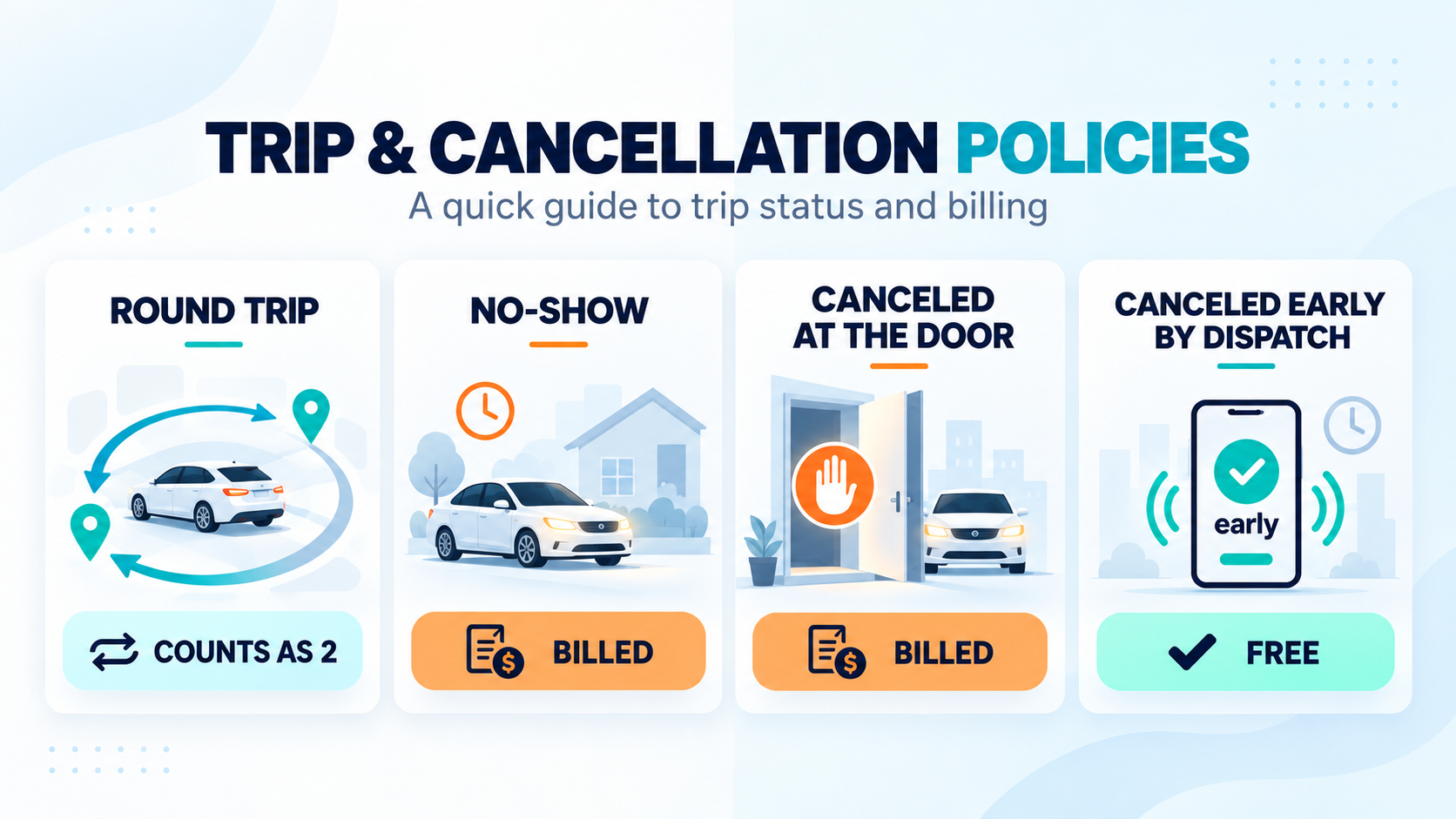
On one published price list, a round trip counts as two managed trips. No-shows are billed. So are trips canceled by a driver at the door. Only trips canceled by dispatch before scheduling are free.
Work through what that means on a normal day. A patient booked both ways who no-shows in the morning still generates two billable trips and zero revenue. In a market with a high no-show rate, you are paying software fees on work you were never paid for.
Three questions worth asking any per-trip vendor:
- Does a round trip count as one trip or two?
- Do you bill no-shows and door cancellations?
- What counts as canceled early enough to be free?
None of this makes per-trip pricing a bad model. It makes the headline rate a bad way to judge fleet software pricing.
The Costs That Sit Outside the Price Model
Both models carry extras, and these are where two similar quotes separate.
- Extra broker connections, which can carry their own monthly fee
- Text message and reminder credits
- Phones or tablets for drivers
- Clearinghouse or billing service fees, if billing is not included
- Paid setup, training or data transfer
One published list charges $100 a month once you add a second broker connection. Small lines like that move a real bill more than the difference between two headline rates.
Ask every vendor for a written list of charges beyond the base price. A vendor who cannot produce one quickly is telling you something about the invoice you will get later.
Free Trials, Setup Fees and Contracts
Whichever model you pick, three terms decide how much risk you carry while you find out if it suits you.
- Is there a setup or onboarding fee?
- Is there a minimum term, or is it month to month?
- How much can the price rise at renewal?
Several NEMT vendors publish no setup fees and no contracts, but publishing it and writing it into your agreement are two different things. Get all three answers in writing before you move your trips across.
A free trial matters more than any of them. Fleet software pricing on paper tells you what a month costs. A trial tells you whether your dispatcher can actually run a day on it, and that is the expensive part to get wrong.
How Darter Prices It?
Darter uses custom pricing rather than a published per-van or per-trip rate. There is no setup fee, there is a free trial, and you can cancel any time.
The reason is the one this whole article describes. A 6-van fleet doing 40 trips a day and a 6-van fleet doing 90 trips a day have very different operations, and a single published rate serves one of them badly. The fee calculator on the home page gives you an approximate figure before you talk to anyone.
Whatever you end up choosing, compare fleet software pricing the same way: your real trip count, your real van count, and a look at next year rather than this month.
Measure Your Real Fleet Utilization
Calculator Download Form
Which Model Fits Your Fleet?
Four questions settle the fleet software pricing question for most owners.
| If this describes your fleet | Lean toward |
|---|---|
| Your volume swings more than 30% across the year | Per trip, which protects you in slow months |
| Your vans are busy and steady | Per van, which is usually cheaper |
| You are about to win more trips without adding vans | Per van, which protects you as trips grow |
| Several vans sit idle most weeks | Per trip, because every idle van favors it |
Then price the fleet you expect to run in twelve months, not the one parked outside today. Software you outgrow in a year is not a saving.
Once you have the shape of the bill, the rest of the decision is broker connections, routing and the driver app, which our software comparison guide walks through step by step.
If you want a figure built around your own vans and trips, start a free trial of Darter and run a real week through it.